
 English
 中文
中文
 Русский
 한국어
한국어
 Español


In order to ensure the quality and excellence of the installation process and provide customers with stable and comfortable home medical examinations, Schmieper New Air has formulated extremely strict precision installation standards, taking every detail to the extreme.
1、 Construction process
1. Design scheme and construction drawings (designer).
2. On site design handover (owner, designer, supervisor, construction personnel).
3. Preparation of construction materials (early equipment and material entry).
4. Equipment pipeline positioning (equipment pipeline size positioning and layout).
5. Equipment pipeline hoisting (hoisting and fixing according to the layout position).
6. Engineering acceptance and delivery to the owner.

The construction specifications should comply with the current mandatory national standards and regulations, and the construction process must adhere to the principle of safety first. The use of electrical appliances must comply with national construction standards, pay attention to fire prevention, and promptly clean up garbage.
2、 Preparation of design scheme and construction drawings
1. Design specifications.
2. Original floor plan.
3. Layout plan.
4. Diagram of relative position of pipelines.
5. Circuit and electrical diagrams.
6. Submit to the owner for signature and approval.
3、 Construction organization design
1. Project Overview.
2. Preparation for commencement of construction.
3. Construction deployment and construction plan.
4. Construction schedule plan.
5. Construction site layout plan.
6. Supply plan for labor, mechanical equipment, materials, and components.
7. Organizational planning for construction site operations.
8. Determination of main technical and economic indicators.
Among the above basic contents, items 3, 4, and 5 are the core parts of construction organization design.
4、 Preparation for commencement
1. Before construction, the owner needs to assist in obtaining a construction permit.
2. Safety warning signs must be placed at the construction site.
3. Fire extinguishers should be installed on the construction site, and attention should be paid to fire prevention.
4. It is strictly prohibited to randomly connect or build electrical wires on the construction site, and attention should be paid to electrical safety.
5、 Tool preparation
1. Tools: grinding wheel saw, hand-held electric drill, impact drill.
2. Tools: Hand saw, scissors, adjustable wrench, homemade wrench, fork wrench, hammer, shovel, square file, screwdriver, etc.
3. Other tools: wall detector, level ruler, compass, plumb line, small wire, box ruler, etc.
6、 Material preparation

7、 Specific process flow
1. According to the construction drawings, conduct on-site layout and confirm the position of wall openings.
2. According to the installation specifications, drill the screw hole. (Be careful to avoid existing pipelines).
3. Equipment hoisting, pipeline hoisting. If there is insufficient space for pipeline crossing, a beam crossing device can be used to avoid pipeline crossing as much as possible. Pipelines passing through walls need to be fitted with sleeves and sealed with fire-resistant insulation materials. After the pipeline installation is completed, insulation is required.
4. Laying conduit and laying out wires. There should be no joints or twisting of wires inside the conduit, leaving 40% of the space inside. The wires inside the conduit can be pulled or changed at any time. 2.5mm ² maximum of 4 tubes (referring only to a single 20 wire tube).
5. Branch connectors should not exceed two at the same location in the socket box, header box, and connector wiring, and there should be appropriate margin in the box for the wires.
8、 Precautions for installation of fresh air fan
1. Determine the installation position based on the external dimensions of the fresh air fan.
2. Install the fresh air fan near the exterior wall or window of the house.
3. There should be sufficient space on the right side of the installation position of the wall mounted fresh air fan to facilitate the replacement of the filter element.
4. When installing a wall mounted fresh air fan, the optimal distance from the bottom to the ground is 80-150mm.
5. When installing cabinet style fresh air fans, the distance between external air ducts should be at least 50cm to prevent airflow short circuits.
6. When selecting the location of external fresh air ducts, they should avoid the discharge outlets of other indoor equipment.
9、 Precautions for wall openings
1. Before opening the hole, ensure that there are no drainage pipes, wires and cables, air conditioning units, etc. on the outer wall of the hole.
2. Be well protected against dust and water when opening holes to prevent dust and sewage from contaminating furniture, appliances, curtains, home decor, and walls.
3. When drilling, tilt the water drill downwards at 3-5 degrees to prevent rainwater from flowing back.
10、 Installation of the main unit of the fresh air system
1. According to the external dimensions of the host, make its fixed frame and perform rust prevention treatment.
2. The host should be installed in non fresh air areas such as kitchens, bathrooms, and storage rooms as much as possible. It should not be installed in rooms with low noise requirements such as bedrooms and study rooms, but should also be installed in rooms closer to the outside.
3. Install the host horizontally on the top of the house, as close as possible to the living room connected to the air intake. The distance between the outdoor fresh air inlet and exhaust outlet should be greater than 1 meter, and the exhaust outlet in the form of upper and lower holes should be located below the fresh air outlet.
4. The household type fresh air unit should be installed in the ceiling, and a 500 * 500 inspection port should be left near the installation position of the ventilation unit for easy maintenance and upkeep. Ensure that there is sufficient disassembly space on the disassembly side of the filter section, total heat exchange core, etc., and there should be no obstacles within 60cm in the direction of the access door.
5. According to the motor power and voltage of the ventilation host, configure the power cord. The power supply should be independently supplied, the wiring should be correct and firm, and have good grounding. It should not be exposed to the outside.
6. A suspension rod with a specification of not less than 8mm should be used to ensure that the support and hanger are firm and stable.
7. The pipeline and equipment are connected using specialized soundproof hoses, and the connection should be sealed with specialized adhesive tape or aluminum foil tape to prevent any airflow leakage on site.
8. Outdoor fresh air ducts must be insulated or insulated with flexible hoses (in northern regions). The exhaust duct should use a flexible hose with a length not exceeding 5m, and UPVC ducts should be used if it exceeds this length. When using UPVC pipes for air ducts and flexible hose connections for air vents, the length of the hose should not exceed 35cm.
9. The airflow direction of the host must be connected according to the direction indicated by the equipment, and flexible hoses must be used to ensure its curvature radius and smooth and reasonable ventilation.
10. The installation of insulation hose pipe supports should not exceed 1 meter to ensure that the ventilation pipes do not fall.
11. A 3-hole socket is reserved on the indoor side of the fresh air host, and a 4 * 0.75mm ² shielded control wire is connected between the host and the controller. (The host comes with a power plug, please do not cut off the plug).
Example diagram using central fresh air fan as an example
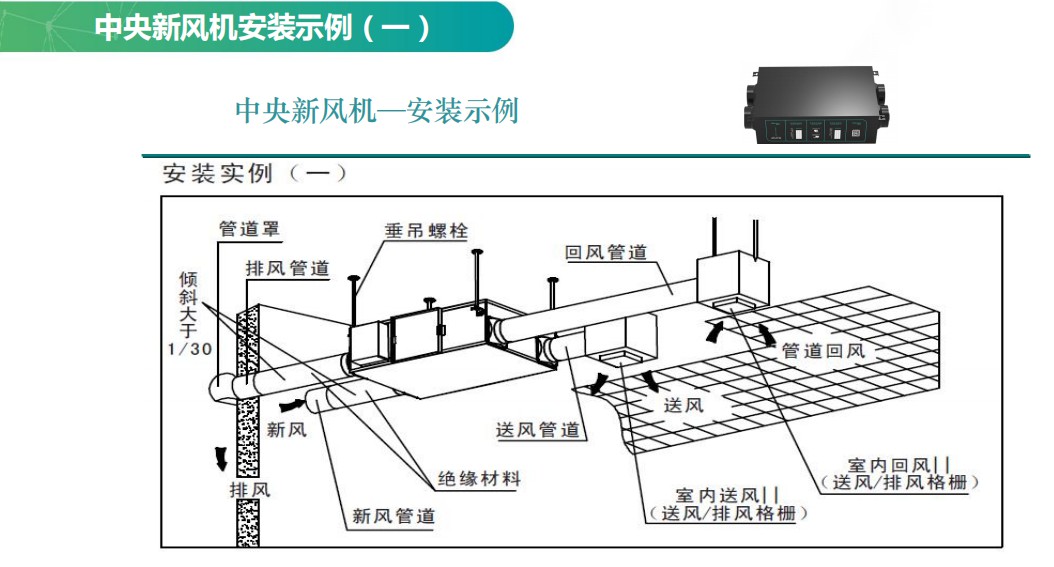

11、 Installation of ventilation ducts
1. The direction and diameter of the pipeline, as well as the installation position of the air outlet, should comply with the requirements of the drawings.
2. The cutting edge of the pipe should be smooth and free of burrs. The connection between the pipe and the fittings should be riveted or firmly bonded, and there should be no residual glue left on the pipe or fittings.
3. The installation of pipelines should be horizontal and vertical, and the inner diameter of the pipes should be clean and free of debris.
4. UPVC pipelines should be fixed using supports and hangers.
12、 Installation of ventilation system vents
1. The surrounding area of the air intake device must be filled and sealed with foaming agent, and waterproofed.
2. When installing the exhaust outlet, choose a hole that is close to the host and can be connected to the outside.
3. The air inlet and outlet should be located in a location with relatively clean outdoor air.

13、 Installation method of outdoor pipe cover

14、 Construction precautions for outdoor pipe covers

15、 Construction of outdoor side air ducts

16、 Installation method of outdoor side air duct
1. The connection between the machine interface and the outdoor air duct is wrapped with aluminum sealing tape to prevent air leakage.
2. Use ventilation pipes with appropriate machine diameter. (The diameter of the outdoor side air duct cannot be smaller than the machine interface diameter)
3. The two ventilation pipes on the indoor side (outdoor suction and discharge) must be insulated to prevent condensation. (Material: Centrifugal glass wool, 25mm thick)
4. When the metal ventilation pipe passes through metal Flat noodles, wire Flat noodles and metal plate, insulation treatment shall be carried out between the pipe and the wall.
17、 Construction schematic diagram of outdoor side air duct


18、 Machine installation - Set up detection port

19、 Debugging of fresh air system
1. During the construction period after the commissioning of the fresh air system, its operation and use are strictly prohibited.
2. Before installing the ceiling, power on the main unit. Check the air supply situation of each air outlet, adjust the air volume control valve in place, and use an anemometer to measure the wind speed to calculate whether the air volume of each air outlet meets the design requirements.
3. After the top ceiling is installed, check whether the removal of the unit's filter section and total heat exchange core is convenient. If they do not meet the requirements, they should be improved in a timely manner.
4. Before pouring concrete into the ceiling, the ground air supply system should be powered on and the main unit should be turned on. Check the air supply situation of each air outlet, adjust the air volume control valve in place, and use an anemometer to measure the wind speed to calculate whether the air volume of each air outlet meets the design requirements.
5. After equipment debugging is completed, attach construction labels and seal all air vents.
6. Once the device connection is completed, it will be debugged immediately. We will confirm the debugging with the customer and the decoration company in person, and sign the tripartite acceptance confirmation form after completion.
7. Check if the condensate drainage pipe is flowing smoothly.
20、 Acceptance Specification for Ventilation System
1. After the completion of pipeline construction, self inspection work should be carried out on all pipelines.
2. After passing the self inspection, fill out the "Hidden Engineering Acceptance Form" and submit it to the supervisor for acceptance. The concealment of pipelines shall be solved by the owner's civil engineering.
3. Before testing the ventilation host, the power supply voltage should be tested, and the power supply voltage should meet the equipment operation requirements, with voltage fluctuations controlled within ± 5%.
4. Before testing the ventilation host driven by a belt, the belt pulley should be checked for looseness and the tension of the belt should be adjusted.
5. After the ventilation host is powered on, the direction of the fan blades should be checked for correctness. Is the operation of the fan balanced. Are fasteners and parts loose.
6. After the testing of the pipeline system and host is completed, fill out the "Engineering Completion Acceptance Inspection Form" and relevant product information related to the project, and submit it to the supervisor for acceptance. After the supervision acceptance is qualified, the construction of the project is officially completed and enters the product warranty period.
7. After the acceptance of the engineering project, protective measures should be taken for the ventilation host that has not been put into operation, and the power should be cut off.









 Miss Wu
 Miss Wu